Accessibility is not merely a technical requirement, it is the foundation of an equitable digital experience.
In an increasingly digital-first world, websites serve as the primary gateway to information, services, and business opportunities. Yet, when digital interfaces are designed without accessibility in mind, they can inadvertently exclude individuals with disabilities. ADA compliance for websites has consequently become a critical consideration for organisations seeking to strengthen digital inclusion, mitigate legal exposure, and deliver seamless user experiences.
The Americans with Disabilities Act (ADA) establishes a framework for preventing disability-based discrimination, including within digital environments. While the ADA does not prescribe a single technical standard for every website, the Web Content Accessibility Guidelines (WCAG) are widely recognised as the principal benchmark for evaluating digital accessibility.
For enterprises, achieving accessibility is not simply about resolving isolated technical defects. It requires a strategic approach that integrates accessibility into the entire digital ecosystem, from content architecture and interface design to development, testing, and ongoing governance.
What Is ADA Website Compliance?
ADA website compliance refers to the process of making websites accessible to individuals with disabilities, enabling them to perceive, navigate, understand, and interact with digital content effectively.
An accessible website accommodates diverse user requirements, including individuals who rely on screen readers, keyboard navigation, voice recognition software, magnification tools, or alternative input devices.
Organisations commonly align their digital accessibility initiatives with WCAG 2.2 Level AA, while recognising that the appropriate legal and technical requirements depend on the organisation, applicable regulations, and specific circumstances.
Key accessibility considerations include:
- Perceivable Content: Ensuring that information is available through appropriate text alternatives, captions, sufficient contrast, and adaptable presentation.
- Operable Interfaces: Enabling users to navigate interactive elements using keyboards and assistive technologies without unnecessary barriers.
- Understandable Experiences: Maintaining clear language, predictable navigation, consistent layouts, and accessible form interactions.
- Robust Implementation: Ensuring compatibility with current and evolving assistive technologies, browsers, and accessibility APIs.
Accessibility transforms digital interfaces from potential barriers into meaningful opportunities for participation.
Why ADA Compliance for Websites Matters to Modern Enterprises
Digital accessibility has evolved beyond a usability enhancement into a fundamental component of corporate responsibility, regulatory preparedness, and sustainable digital strategy.
For enterprises operating across industries, inaccessible digital assets can create friction across customer journeys, compromise service delivery, and expose organisations to legal and reputational risks.
A proactive accessibility strategy enables organisations to address these challenges while establishing a more resilient digital infrastructure.
The business value of website accessibility
- Legal and Regulatory Preparedness: Supports efforts to address applicable accessibility obligations and reduce the risk associated with inaccessible digital experiences.
- Enhanced User Experience: Creates intuitive, navigable, and efficient experiences for users with diverse abilities and interaction preferences.
- Expanded Audience Reach: Enables businesses to engage a broader demographic, including users who depend on assistive technologies.
- Improved Digital Performance: Accessible structures, semantic markup, and descriptive content can complement broader website usability and search optimisation initiatives.
- Strengthened Brand Credibility: Demonstrates a measurable commitment to inclusivity, responsible digital practices, and customer-centric innovation.
Accessibility is not an additional layer of digital sophistication, it is an essential component of digital excellence.
ADA Website Compliance Services: A Strategic Approach to Digital Accessibility
Implementing accessibility across complex digital environments requires more than automated scanning or superficial interface modifications. It demands a comprehensive methodology that combines technical expertise, human-centred evaluation, and sustainable remediation practices.
Professional ADA Website Compliance Services help organisations identify accessibility barriers, prioritise remediation activities, and establish processes that support long-term accessibility conformance.
At Accessible Minds, digital accessibility initiatives can be approached through a structured framework encompassing assessment, remediation, validation, and continuous improvement.
Core components of ADA Website Compliance Services
- Comprehensive Accessibility Audits: Evaluate website structures, interactive components, content, and user journeys against relevant WCAG success criteria.
- Automated and Manual Testing: Combine accessibility scanning with expert evaluation to identify issues that automated tools cannot reliably detect.
- Assistive Technology Testing: Assess usability with screen readers, keyboard navigation, and other relevant assistive technologies.
- Accessibility Remediation: Address issues involving semantic HTML, heading structures, alternative text, colour contrast, focus indicators, forms, and interactive elements.
- WCAG Conformance Validation: Reassess remediated components to determine whether identified accessibility barriers have been resolved.
- Ongoing Accessibility Governance: Establish repeatable testing, documentation, and monitoring processes to help prevent accessibility regressions.
An effective accessibility programme does not end when an audit report is delivered. Its real value lies in translating technical findings into measurable, sustainable improvements.
WCAG and ADA: Understanding the Relationship
The ADA and WCAG serve distinct but interconnected purposes within the digital accessibility landscape.
The ADA is a United States civil rights law that prohibits discrimination against individuals with disabilities. WCAG, developed by the World Wide Web Consortium (W3C), provides technical success criteria for making web content accessible.
Although WCAG is not itself a statute, it is widely used as a technical reference for accessibility implementation, evaluation, and remediation.
How WCAG supports ADA website accessibility
- WCAG 2.1 and WCAG 2.2: Provide internationally recognised accessibility criteria for digital content and interfaces.
- Level A: Addresses foundational accessibility requirements.
- Level AA: Covers additional requirements commonly adopted as a target for organisational accessibility programmes.
- Level AAA: Represents a more stringent conformance level that may not be practical or achievable for every type of content.
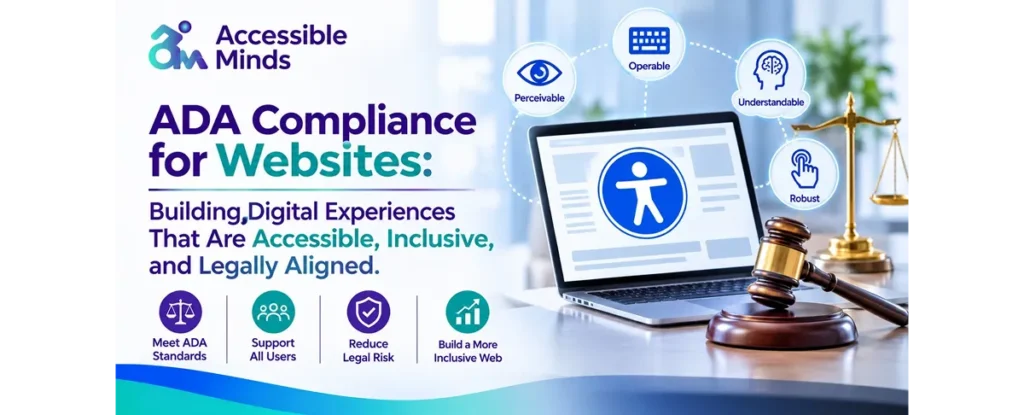
WCAG is organised around four fundamental principles: Perceivable, Operable, Understandable, and Robust (POUR).
For organisations seeking to strengthen their digital accessibility posture, WCAG provides a structured foundation for identifying, evaluating, and addressing accessibility barriers.
How to Make a Website ADA Compliant
Achieving website accessibility requires a systematic process that integrates technical evaluation with practical remediation and continuous validation.
Organisations can strengthen their accessibility initiatives through the following steps:
- Evaluate the Existing Website: Conduct a comprehensive accessibility assessment to establish a baseline and identify critical barriers.
- Prioritise Accessibility Defects: Address high-impact issues that prevent users from accessing essential information, navigating interfaces, or completing transactions.
- Implement Technical Remediation: Correct underlying code, semantic structures, interactive behaviours, and content-related accessibility deficiencies.
- Validate with Assistive Technologies: Test relevant user journeys using keyboard navigation, screen readers, and other assistive technologies.
- Establish Continuous Monitoring: Integrate accessibility checks into development workflows, content publishing, and quality assurance processes.
A sustainable accessibility strategy embeds inclusion into the development lifecycle rather than treating compliance as a one-time corrective exercise.
Advancing Digital Inclusion Through Accessibility
ADA compliance for websites represents a critical intersection of digital responsibility, user experience, and regulatory awareness. As organisations increasingly depend on digital platforms to deliver essential services and business value, accessibility must become an integral part of their digital transformation strategies.
Investing in professional ADA Website Compliance Services enables enterprises to identify accessibility barriers, implement meaningful remediation, and establish a more inclusive digital environment.
However, accessibility is not a static achievement. Evolving technologies, changing content, and continuous website enhancements require an ongoing commitment to evaluation, validation, and improvement.
The ultimate objective is not merely to make websites compliant, it is to make digital experiences accessible, equitable, and empowering for everyone.
Accessible Minds supports organisations in advancing digital accessibility through structured assessment, remediation, and accessibility-focused expertise.
Explore accessibility solutions at Accessible Minds.