India’s Fashion Shoppers Are on Mobile. Is Your Shopify Store Actually Ready for Them?
With over 700 million smartphone users in India, mobile-first isn’t a trend — it’s the only eCommerce strategy that matters.
India is a mobile-first nation.
Over 700 million smartphone users. More than 60% of all eCommerce transactions happening on phones. Fashion is among the most mobile-dominant categories of all — driven by Instagram discovery, WhatsApp sharing, and impulse purchasing during commutes and breaks.
For Indian clothing brands selling on Shopify, this is not a future consideration. It is the current reality that every single development decision must account for.
“The Indian fashion shopper is typically on a mid-range Android phone, on mobile data, browsing at night or during a commute. If your store isn’t built for that exact context, you’re not really building for your customer”
— Karam Singh, Founder, Miracle Websoft
Karam Singh is a Shopify Certified Developer and founder of Miracle Websoft, which has built and optimised Shopify stores for 50+ fashion brands across India, the USA, UK, and Australia. His team builds every store with Indian mobile users as the primary design context.
What Mobile-First Actually Means
Mobile-first does not mean making a desktop site and adjusting it for mobile. It means designing and developing the mobile experience first — and then adapting for larger screens.
In practical terms for fashion brands. Images sized for 375px screen widths. Font sizes readable without zooming. Checkout flows navigable with a single thumb. Product videos that stream without buffering on variable mobile connections. Fabric information and size guides accessible within two taps, not collapsed into menus three scrolls down.
Most Shopify stores are designed on a 27-inch monitor. The customer is using a 6-inch phone. This gap costs sales every single day.
The Speed Dimension Is Non-Negotiable
53% of mobile visitors abandon a site that takes longer than 3 seconds to load. For Indian mobile connections — fast but variable — this threshold is critical.
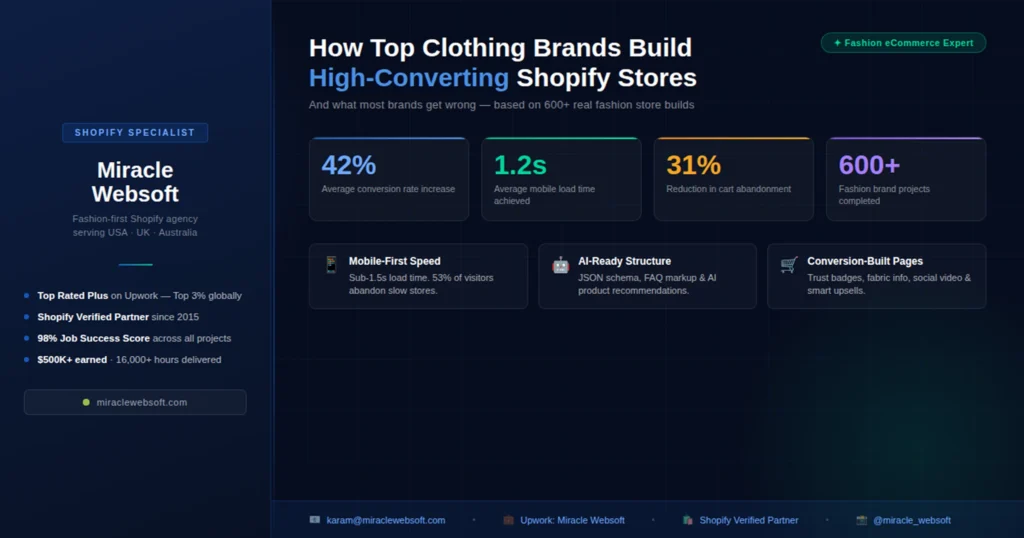
Miracle Websoft’s mobile benchmark. Sub-1.5 seconds on a standard 4G connection. Achieving this requires deliberate decisions about image formats (WebP over JPG/PNG), JavaScript loading strategy, Shopify app usage, and theme code quality.
A luxury fashion brand they worked with had a mobile load time of over 6 seconds. After a full performance overhaul, it hit 1.1 seconds. The improvement in mobile conversion was visible within two weeks.
The Four Mobile Elements Fashion Brands Get Wrong
Button sizes. Add to Cart buttons designed for mouse clicks, not thumb taps. On mobile, any button smaller than 44×44 pixels creates friction that costs conversion.
Image loading. Fashion stores with 8–12 high-resolution images can take 10+ seconds to fully load on a 4G connection. WebP format, lazy loading, and correct image sizing fix this.
Size guide placement. Fashion shoppers need size guidance before they buy. If finding the size guide requires three scrolls and a tap, many won’t bother — and they’ll either guess wrong and return the item, or not buy at all.
Video implementation. Social video on product pages is one of the most powerful conversion tools in fashion eCommerce — but only when implemented correctly for mobile bandwidth.
The Bottom Line
For Indian clothing brands, mobile optimisation is not optional. It is the foundation of everything else — advertising, social media, influencer campaigns — all of which drive traffic to a store that must perform on the device those customers are actually using.
Miracle Websoft offers a free mobile performance audit for clothing brands. The audit measures actual mobile load time on a real connection, identifies the specific causes of slowness, and quantifies what fixing it is worth in recovered revenue.
About Miracle Websoft
Miracle Websoft is a Shopify-specialist agency founded by Karam Singh, building high-converting stores exclusively for fashion and clothing brands across the USA, UK, and Australia.